YOUR STRATEGY IS MISSING A SYSTEM
The 5P Framework by Trust Insights™
Every organization has goals. Fewer have a repeatable system for reaching them. You’ve sat through the planning meetings, built the spreadsheets, and launched the initiatives — only to watch them stall when the wrong people are in the room, the process is unclear, or the technology doesn’t fit.
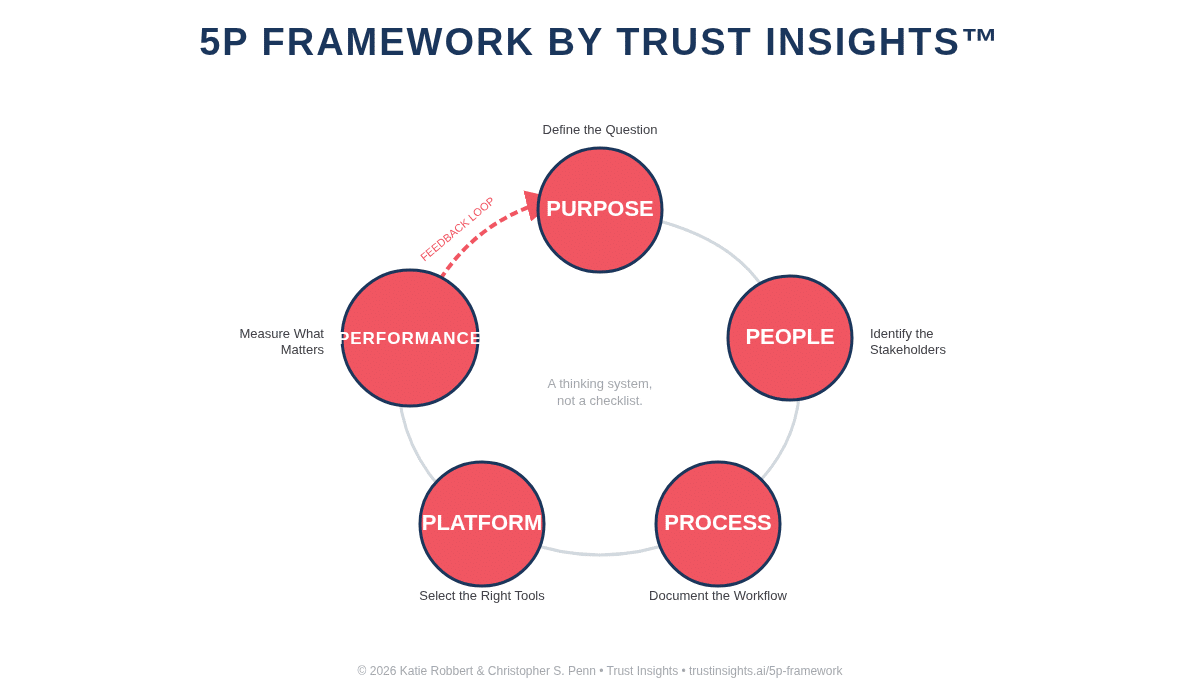
The 5P Framework gives you a structured, sequential methodology that works whether you’re launching a new product, running a marketing audit, or managing organizational change. Five steps. One system. Built from the real-world lesson that “People, Process, Technology” fails when you skip the questions that matter most: why are we doing this, and how will we know it worked?
THE 5P FRAMEWORK + AI
A universal thinking system. With or without AI, it works.
| The 5P Framework | The 5P Framework + AI | |
|---|---|---|
| Purpose | Turn vague goals into measurable questions. Every hour here saves ten hours of rework. The quality of your strategy depends on the quality of the question it starts with. | Use generative AI to decompose fuzzy objectives into specific, testable sub-questions. Feed it your plan and surface the assumptions you haven’t tested — sharper hypotheses in minutes, not days. |
| People | Map stakeholders by role: who decides, who executes, who has institutional knowledge, who blocks progress if left out. The best plan fails without the right people at the table. | AI analyzes org charts, project history, and communication patterns to surface hidden dependencies and skills gaps before they become bottlenecks. A stakeholder analysis that updates itself. |
| Process | Document how work actually gets done — handoffs, approvals, the workarounds nobody admits to. If you can’t write it down, you can’t scale it, delegate it, or improve it. | AI identifies patterns in your workflows, flags bottlenecks, and generates first-draft SOPs from meeting transcripts. Automate what doesn’t require judgment so your team can focus on what does. |
| Platform | Choose tools only after defining the question, mapping people, and documenting the process. The right platform fits your workflow. Stop accumulating shelfware. | AI evaluates tool fit against documented requirements, compares integrations, and models total cost of ownership. Build a scored shortlist in days instead of a 6-month vendor evaluation. |
| Performance | Measure what actually answers the question from Purpose — not vanity metrics. Performance feeds back into Purpose. The framework is a loop, not a checklist. | AI monitors KPIs in real time, detects anomalies before they become crises, and drafts insight reports automatically. Spend your time on decisions, not dashboards. |
THE FIVE Ps
1. PURPOSE — Define the Question
Before you build anything, you need to know what you’re solving for. Purpose is the discipline of turning a vague goal (“we need more leads”) into a measurable question (“what channel mix produces the lowest cost-per-qualified-lead for mid-market SaaS buyers?”). This step forces clarity. It prevents scope creep. And it gives every subsequent step a north star to point toward.
Most teams skip this step entirely. They jump straight to tactics because defining the real question feels slow. But every hour spent here saves ten hours of rework downstream. The difference between a good strategy and a bad one is almost always the quality of the question it started with.
Ask yourself: Can every person on your team articulate — in one sentence — the question your current project is trying to answer?
2. PEOPLE — Identify the Stakeholders
Who needs to be involved, and in what capacity? People isn’t a staffing exercise — it’s a stakeholder map. You need to know who owns the decision, who executes the work, who has the institutional knowledge, and who will block progress if they’re not in the loop. Get this wrong and you’ll build a perfect plan that nobody follows.
This is where most “People, Process, Technology” implementations fail. They treat People as “who do we assign this to?” when the real question is “who needs to be in the room, in what role, and at what stage?” The best strategy in the world doesn’t survive first contact with a stakeholder who wasn’t consulted.
Ask yourself: Do you know who on your team has the skills, authority, and bandwidth to execute — or are you assuming?
3. PROCESS — Document the Workflow
If you can’t write it down, you can’t scale it. Process is where you document — step by step — how the work actually gets done. Not the idealized version. The real one. This includes handoffs, approval gates, and the unofficial workarounds that everyone relies on but nobody admits to. A documented process is the only thing standing between your team and chaos when someone goes on vacation.
The goal isn’t bureaucracy. It’s clarity. When every team member knows what happens next, who’s responsible, and what “done” looks like at each stage, you eliminate the ambiguity that breeds rework, missed deadlines, and finger-pointing. Document the process you have, then improve it. Never the other way around.
Ask yourself: If your best team member quit tomorrow, could someone else follow a written process to keep things running?
4. PLATFORM — Select the Right Tools
Only after you’ve defined the question, mapped the people, and documented the process should you choose the tools. Platform is intentionally the fourth step because most organizations start here — buying software before they know what problem it’s solving. The right platform fits your process. The wrong one forces your team to change how they work to accommodate the tool.
This is the step where discipline pays off. When you arrive at Platform with a clear question, a stakeholder map, and a documented workflow, tool selection becomes almost obvious. You’re matching capabilities to requirements instead of shopping for features. And you’ll stop accumulating shelfware — the tools you bought, onboarded, and quietly abandoned because they solved a problem nobody had defined.
Ask yourself: Did you choose your current tools because they fit your process, or did you change your process to fit the tools?
5. PERFORMANCE — Measure What Matters
The final P closes the loop. Performance is how you measure whether the system is working. Not vanity metrics. Not the KPIs that make the dashboard look good. The metrics that actually answer the question you defined in Purpose. And here’s the key: Performance feeds back into Purpose. When the data tells you something unexpected, you update the question and run the cycle again.
The 5P Framework is a loop, not a checklist. Organizations that treat it as linear — define, staff, document, tool up, report out, done — miss the point. The measurement step exists to challenge your assumptions. If Performance reveals that you asked the wrong question, you go back to Purpose. If it shows the wrong people are in the room, you revisit People. The system improves every time you run it.
Ask yourself: Are you measuring what’s easy to measure, or what actually tells you if your strategy is working?
GO DEEPER
Download the full guide for each version of the framework. Use them in workshops, share them with your team, or bring them to your next planning session.
The 5P Framework
The evergreen guide to the 5P methodology. No AI angle — just the universal thinking system that works for any initiative, any team, any industry.
The 5P Framework + AI
The companion guide showing how AI augments each of the five Ps. Same framework, accelerated. See what changes when you add AI to every step.
 Newsletter
 Podcast